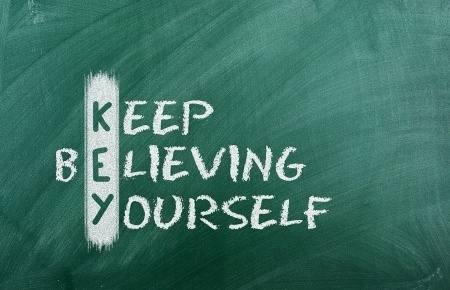
Many of us are not satisfied with ourselves, with some particular features of our character or the results of our own deeds. Psychologists refer to such phenomenon as low self-esteem. So, why don’t we value ourselves? First of all our self-esteem depends on how other people perceive us. We are inclined to base our self-esteem on other people’s opinions. It is especially typical of children. Little children are not able to analyze their activity and their confidence depends on adults’ estimation of their behavior. Besides during all our lives we always compare the image of our ideal “ego “with our real “ego“. And if our real “I “is too far from the ideal our self-esteem suffers from it. But in most cases there are no reasons for that, as our ideal image may be too perfect and unreal.
People with low self-esteem do not hope for success in their activities and they are more likely to act, just trying to escape from our failures. And even when they attain positive results, they attribute their small victories to external factors (the task was too easy; it was just luck). And the feeling of discontent with themselves is growing dramatically. It is a kind of vicious circle: people cannot achieve success, because they are dissatisfied with themselves and on the other hand, they are dissatisfied with themselves because they have never managed to succeed. We should remember that every success starts with your self-confidence, with the belief that you will achieve what you intend to do.
To improve your self-confidence I’ll share an efficient exercise with you. You are expected to make a list of positive features of your character (not less than forty). I know that it is not that easy. But you are not limited for time and you may write when you wish to. Once the list is completed, you are to enrich it with new strong points of your nature every day. Soon, you will see that such a person as described in the list surely deserves respect and you will like him/her.
Learning Strategies
A few basic learning strategies can help you in your career or business. They also can make you the person who always has something interesting to say. You CAN learn more efficiently. Just use a few of the following techniques until they become habit.
Create Anticipation and Curiosity
You learn more effectively with curiosity and anticipation working for you, but how do you create this state of mind? One way is to end each learning session with a question or two clearly in your mind. This creates the sense of anticipation and curiosity that will help you next time you study. It’s like a TV show going to a commercial at an interesting moment in the program. You want to stay tuned, to see what happens next.
Prepare To Learn
When you want to learn new material, expose your mind to it as soon as possible, before you even feel “ready,” or have time to study. The first stage of learning is the part where you look at new ideas and say, “huh?” Do this quickly, however, reviewing everything for a few minutes, and your unconscious mind will start “incubating” the new concepts, and finding some way to organize them.
Relate What You Know To The New Knowledge
When you sit down to study new material, relate it to what you already know. Compare and contrast things, saying to yourself, “That’s like…,” or “How is that different from…”
Use Your Imagination
Changing your perspective is one of the great learning strategies. For example, study with the idea in mind that you will be teaching what you’re learning. As you study something, imagine how you’ll teach it. This is a powerful way to get a good grasp on new information.
Also imagine how you’ll use what you are learning. There’s so much information, and so little of it is the truly “important stuff.” But by imagining how you’ll use the new information, you tend to automatically focus on the things you really need to know.
Take Breaks
You can learn more by working less. The research shows that we remember best what we study first and last in a given session. So, by taking breaks, you create more “sessions,” and increase the number of firsts and lasts. Move around during your breaks, as this can also keep your mind fresh.
Finding Time
What if it took no extra time to learn a new language, take a negotiating course, or study something new and interesting? Start using the dead-time in your day, the time sitting in your car, or on the bus, or in a waiting room. Almost any public library has hundreds of books on tape, and you can even instantly download books on the internet.
This is one of the most under utilised and easiest learning strategies. If your job is 25 minutes away you spend 200 hours per year sitting in your car going to or from work. Could you learn something useful if you had four hours per week of audio instruction for a year? The only extra time it takes is a few minutes to stop by the library.
Of course, almost nothing works just by reading it. Why not scan the list above and start using one or two of these learning strategies right now?